

The Most Desired Goods And Services That Are Given Up In Order To Get More Of Another Good Are The?
2 Defining Economics
Learning Objectives
- Define economic science.
- Explain the concepts of scarcity and opportunity cost and how they chronicle to the definition of economics.
- Understand the fundamental economical questions: What should be produced? How should goods and services exist produced? For whom should goods and services be produced? How much progress can society afford? How can we adjust consumption to product in the short run?
Economics is a social science that examines how people cull amongst the alternatives available to them. It is social because it involves people and their behavior. Information technology is a science because it uses, as much as possible, a scientific approach in its investigation of choices.
Scarcity, Option, and Cost
All choices mean that 1 alternative is selected over another. Selecting amid alternatives involves three ideas primal to economics: scarcity, choice, and opportunity toll.
Scarcity
Our resources are limited. At whatsoever 1 time, we have only so much land, so many factories, so much oil, so many people. But our wants, our desires for the things that we tin produce with those resources, are unlimited. We would ever like more than and better housing, more than and better education—more and better of practically everything.
If our resource were also unlimited, we could say aye to each of our wants—and there would exist no economics. Because our resources are express, nosotros cannot say yeah to everything. To say yep to i thing requires that we say no to another. Whether we like it or not, nosotros must make choices.
Our unlimited wants are continually colliding with the limits of our resource, forcing united states to pick some activities and to reject others. Scarcity is the condition of having to cull amongst alternatives. A deficient proficient is one for which the choice of one alternative requires that another be given up.
Consider a parcel of state. The parcel presents us with several culling uses. We could build a firm on information technology. Nosotros could put a gas station on it. We could create a small park on it. We could exit the land undeveloped in club to exist able to brand a conclusion afterwards as to how it should be used.
Suppose we have decided the land should exist used for housing. Should information technology be a large and expensive house or several modest ones? Suppose it is to be a large and expensive house. Who should alive in the house? If the Lees alive in it, the Nguyens cannot. At that place are alternative uses of the state both in the sense of the type of use and also in the sense of who gets to use it. The fact that country is scarce means that guild must brand choices apropos its use.
Virtually everything is deficient. Consider the air we breathe, which is available in huge quantity at no accuse to usa. Could information technology peradventure exist scarce?
The exam of whether air is scarce is whether it has culling uses. What uses tin can we make of the air? We breathe it. We pollute it when we drive our cars, heat our houses, or operate our factories. In effect, one utilise of the air is equally a garbage dump. We certainly need the air to breathe. But only equally certainly, we choose to dump garbage in information technology. Those two uses are clearly alternatives to each other. The more garbage we dump in the air, the less desirable—and healthy—it will exist to exhale. If nosotros decide we want to exhale cleaner air, we must limit the activities that generate pollution. Air is a scarce skillful because it has alternative uses.
Not all goods, however, face up us with such choices. A gratuitous skillful is one for which the option of one utilise does not require that we surrender another. I instance of a free good is gravity. The fact that gravity is holding yous to the globe does non mean that your neighbor is forced to drift up into space! Ane person's use of gravity is non an alternative to another person's apply.
In that location are not many free goods. Outer space, for example, was a free good when the only use nosotros fabricated of information technology was to gaze at it. Merely now, our utilise of space has reached the point where i use tin be an alternative to another. Conflicts have already arisen over the allocation of orbital slots for communications satellites. Thus, even parts of outer space are deficient. Space will surely get more scarce equally nosotros discover new ways to use it. Scarcity characterizes about everything. Consequently, the telescopic of economics is broad indeed.
Scarcity and the Central Economic Questions
The choices nosotros confront every bit a upshot of scarcity raise these fundamental questions, which every economy must respond:
- What should be produced? Using the economic system's scarce resources to produce one thing requires giving upward another. Producing ameliorate instruction, for case, may require cutting back on other services, such as health care. A conclusion to preserve a wilderness area requires giving upward other uses of the country. Every gild must make up one's mind what information technology will produce with its scarce resources.
- How should goods and services be produced? There are all sorts of choices to be made in determining how goods and services should exist produced. Should a business firm utilize a few skilled or a lot of unskilled workers? Should it produce in its ain country or should it employ foreign plants? Should manufacturing firms use new or recycled raw materials to brand their products?
- For whom should goods and services be produced? If a good or service is produced, a decision must be made about who will get it. A determination to accept 1 person or group receive a practiced or service normally ways it will not be bachelor to someone else. For example, representatives of the poorest nations on globe often mutter that energy consumption per person in the United States is 17 times greater than free energy consumption per person in the earth'south 62 poorest countries. Critics debate that the globe's energy should be more evenly allocated. Should it? That is a "for whom" question.
- How much progress gild can afford or cares to have at the cost of sacrificing present values and what forms it should it shall take? What choices should a society make to maintain and ameliorate the social structure? These can include infrastructure investments such as roads, sewers, and Internet; public health interventions, healthcare, or education.
- How should we conform consumption to production within very brusk periods? When there is a negative supply shock, such as the 1970's oil embargo, or a negative demand shock, such as the 2008 financial crunch, the regime has an opportunity to stride in and adjust the economic system to support consumers and businesses. How much they choose to practise and so is a question both of economic fundamentals and the values of the society in which the economy operates.
We shall return to these questions again and over again.
Opportunity Cost
It is within the context of scarcity that economists define what is perhaps the most important concept in all of economics, the concept of opportunity cost. Opportunity cost is the value of the best culling forgone in making any option.
The thought of "value" in economics has been the subject of debate for hundreds of year. Classical economic theory, starting with Adam Smith, identifies value, and its necessary inverse, price, in terms of productive cost. Here, opportunity costs takes on a simplistic caption, an objective value, comparing the output of a day'south labor between two people, with wages justified in part or whole by the physical nature of the work[1]. Following the development of marginal utility theory, the details of which will exist investigated in later chapters, and so developed the concept of value, and therefore opportunity cost as a subjective entity. This led to the idea of opportunity cost as it is written here, and in most economics texts, equally the alternative employ of a resources.
The opportunity cost to you of reading the remainder of this chapter will exist the value of the best other utilize to which you could accept put your time. If you choose to spend $twenty on a potted plant, you have simultaneously chosen to give upwardly the benefits of spending the $20 on pizzas or a paperback book or a nighttime at the movies. If the volume is the most valuable of those alternatives, then the opportunity cost of the plant is the value of the enjoyment y'all otherwise expected to receive from the volume.
The concept of opportunity cost must not be confused with the buy price of an item. Consider the cost of a higher or academy education. That includes the value of the all-time alternative apply of money spent for tuition, fees, and books. But the about important price of a college education is the value of the forgone alternative uses of fourth dimension spent studying and attending class instead of using the time in another try. Students cede that time in hopes of even greater earnings in the future or considering they place a value on the opportunity to learn. Or consider the cost of going to the md. Function of that cost is the value of the best alternative use of the money required to come across the medico. But, the cost also includes the value of the best alternative utilise of the time required to see the doctor. The essential affair to see in the concept of opportunity cost is constitute in the proper noun of the concept. Opportunity price is the value of the all-time opportunity forgone in a particular choice. It is non simply the amount spent on that choice.
The concepts of scarcity, pick, and opportunity cost are at the heart of economics. A good is deficient if the option of one alternative requires that another be given up. The existence of culling uses forces u.s. to make choices. The opportunity price of any choice is the value of the all-time alternative forgone in making it.
Fundamental Takeaways
- Economics is a social science that examines how people choose amid the alternatives available to them.
- Scarcity implies that we must surrender one alternative in selecting another. A good that is non deficient is a gratuitous proficient.
- The fundamental economic questions are: What should be produced? How should appurtenances and services be produced? For whom should goods and services be produced? How much progress society can afford? How should we adjust to brusk run changes?
- Every choice has an opportunity toll and opportunity costs affect the choices people make. The opportunity price of any pick is the value of the best alternative that had to exist forgone in making that choice.
Try It!
Identify the elements of scarcity, selection, and opportunity cost in each of the following:
- The Ecology Protection Agency is considering an guild that a 500-acre area on the outskirts of a big city be preserved in its natural country, because the area is abode to a rodent that is considered an endangered species. Developers had planned to build a housing evolution on the country.
- The manager of an automobile assembly plant is considering whether to produce cars or sport utility vehicles (SUVs) next calendar month. Assume that the quantities of labor and other materials required would be the same for either type of production.
- A young man who went to work every bit a nurses' aide after graduating from high school leaves his job to get to college, where he will obtain training as a registered nurse.
Case in Point: The Rising Cost of Energy
Figure i.ane
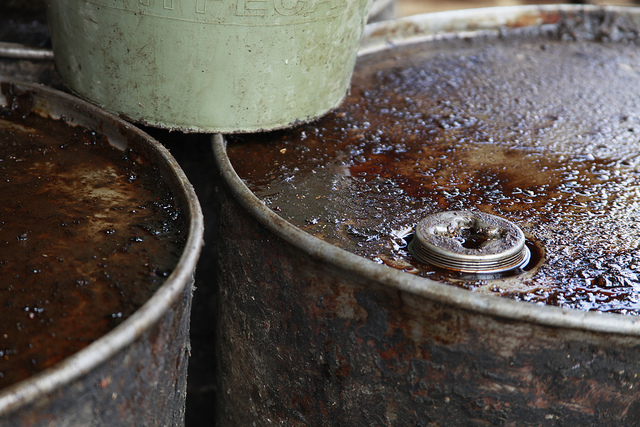
IFPRI – IMAGES – oil barrels – CC BY-NC-ND 2.0.
Oil is an exhaustible resource. The oil we burn down today will not exist available for utilise in the futurity. Part of the opportunity cost of our consumption of goods such equally gasoline that are produced from oil includes the value people in the future might have placed on oil we utilize today.
It appears that the cost of our use of oil may exist ascension. We have been using "light crude," the oil found in the footing in deposits that can be readily tapped. Equally low-cal crude becomes more scarce, the world may need to turn to so-called "heavy crude," the crude oil that is found in the sandy soil of places such as Canada and Venezuela. That oil exists in such abundance that it propels Venezuela to the top of the world list of available oil. Kingdom of saudi arabia moves to the second position; Canada is third. The US is 11th, and most of that oil is not easily extractable. Recently, technologies like fracking have been used to access this oil, and it has consequences.
The difficulty with the oil mixed in the sand is that extracting it is far more costly than calorie-free crude, both in terms of the expenditures required and in terms of the environmental harm that mining it creates. Northern Alberta, in Canada, boasts a Florida-sized area whose sandy soils are rich in rough oil. Some of that oil is ane,200 feet secret. Extracting information technology requires pumping steam into the oily sand and so pumping up the resultant oily syrup. That syrup is then placed into huge, industrial-sized washing machines that split up crude oil. What is left over is toxic and volition be placed in huge lakes that are being created by digging pits in the ground 200 feet deep. The oil produced from these sands has go important—Alberta is the largest strange supplier of oil to the United States.
Sands that are closer to the surface are removed past bulldozers and giant cranes; the forest over it is cleared away. The oily sand is and so hauled off in two-story dump trucks which, when filled, weigh more than a Boeing 747. Total SA, a French company, is leading the race to develop Canada'southward oil. Jean Luc-Guiziou, the president of Total SA'southward Canadian operations, says that the extraordinarily costly process of extracting heavy crude is something the globe is going to have to get used to. "The light crude undiscovered today is getting scarcer and scarcer," he told The Wall Street Journal. "Nosotros take to accept the reality of geoscience, which is that the next generation of oil resource volition exist heavier."
Already, Total SA has clear-cut thousands of acres of forest land in social club to gain access to the oily sand below. The process of extracting heavy crude oil costs the company $25 a barrel—compared to the $6 per butt toll of extracting and refining light rough. Extracting heavy crude generates iii times as much greenhouse gas per barrel as does light crude. By 2015, Fort McMurray, the small-scale (population 61,000) town that has become the headquarters of Northern Alberta'south crude oil boom, will emit more greenhouse gas than the entire country of Denmark (population 5.4 million). Canada volition exceed its greenhouse gas quota set by the Kyoto Accords—an international treaty aimed at limiting global warming—largely as a result of developing its heavy crude deposits.
No ane even considered the extraction of heavy crude when light crude was cheap. In the tardily 1990s, oil price merely $12 per barrel, and deposits of heavy rough such as those in Canada attracted picayune attention. By mid-2006, oil sold for more than $seventy per barrel, and Canada'southward heavy crude was all of a sudden a hot commodity. "It moved from existence just an interesting experiment in northern Canada to really this is the time to come source of oil supply," Greg Stringham of the Canadian Association of Petroleum Producers told Al Jazeera.
Alberta's free energy minister, Greg Melchin, defends the province'due south decision to proceed with the exploitation of its oily sand. "At that place is a cost to it, but the benefits are substantially greater," he insists.
Not everyone agrees. George Poitras, a fellow member of the Mikisew Cree tribe, lives downstream from the oil sands development. "Y'all see a lot of the land dug upward, a lot of the boreal woods struck downwardly and it'due south upsetting, it fills me with rage," he says. Diana Gibson of the Parkland Institute, an environmental advocacy group, says that you can see the ecology damage generated past the extraction of oil sands around Fort McMurray from the moon. "What we are going to be having is destruction of very, very valuable ecosystems, and permanent pollution," she says.
Sources: "Alberta's Heavy Oil Burden," Al Jazeera English, March 17, 2008 (see english.aljazeera.net); and Russell Gilded, "As Prices Surge, Oil Giants Turn Sludge into Aureate," The Wall Street Journal Online, March 27, 2006, A1.
Answers to Endeavor It! Issues
- The 500-acre area is scarce because it has culling uses: preservation in its natural country or a site for homes. A pick must be fabricated between these uses. The opportunity cost of preserving the land in its natural country is the forgone value of the country as a housing development. The opportunity cost of using the state every bit a housing development is the forgone value of preserving the state.
- The scarce resources are the plant and the labor at the establish. The manager must choose between producing cars and producing SUVs. The opportunity cost of producing cars is the profit that could be earned from producing SUVs; the opportunity cost of producing SUVs is the profit that could be earned from producing cars.
- The man tin can devote his fourth dimension to his current career or to an education; his time is a scarce resource. He must cull betwixt these alternatives. The opportunity cost of continuing as a nurses' aide is the forgone benefit he expects from training as a registered nurse; the opportunity cost of going to college is the forgone income he could have earned working full-time as a nurses' aide.

The Most Desired Goods And Services That Are Given Up In Order To Get More Of Another Good Are The?,
Source: https://uw.pressbooks.pub/microman/chapter/1-1-defining-economics/
Posted by: gutierrezdialt1955.blogspot.com
0 Response to "The Most Desired Goods And Services That Are Given Up In Order To Get More Of Another Good Are The?"
Post a Comment